GK106 GPU contents

|
xtreview is your : Video card - cpu - memory - Hard drive - power supply unit source |
|
|||
|
|
||||


 Recommended : Free unlimited image hosting with image editor
|
POSTER: computer news || GK106 GPU CONTENTS |
DATE:2012-09-06 |
|
|
Shortly before the announcement of the first graphics solution based on Kepler architecture , we have had the opportunity to study the schematic structure of GK104 processor and estimate the scale of changes that NVIDIA has made since Fermi architecture . First Kepler received four blocks Graphics Processing Cluster (GPC), which contains eight multiprocessors SMX 1536 CUDA cores . 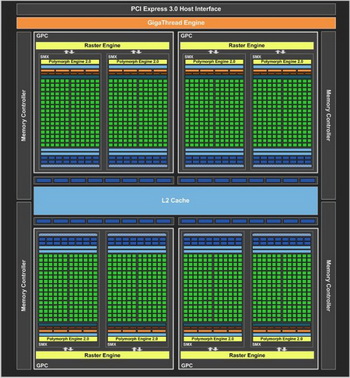 Younger decision - GeForce GT 640 GK107 processor - has only one GPC and, accordingly, two multi-processor with 384 cores CUDA. the scheme is as follows: 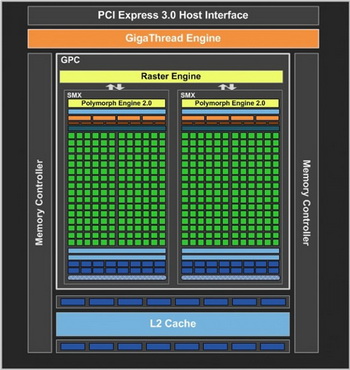 Associate published the schema of GK106 processor. Interestingly, one of the three blocks GPC solution consists of a single multiprocessor. Thus, in the circuit are 5 SMX and 960 cores CUDA. Other elements that somehow affects GPU performance, you can also count, just remember part of a multiprocessor:
The cluster does not include the power distribution GigaThread Engine, second cache level, bitmap blocks (a total of 24 ROP) and three blocks of memory controller: 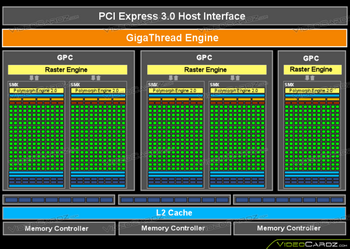 So far we know only one product on base of GK106 processor - this is the GeForce GTX 660. However, based on this GPU will be released, at least four products.  GK106-400 will be known as the GeForce GTX 660 with 960 cores CUDA, 2 GB memory and 192-bit bus access. Modest GK106-250 (maybe, GeForce GTX 660 SE) - one multiprocessor is likely to disabled and remain 768 cores CUDA. Finally, GK106-200 version will be the base for the GeForce GTX 650 Ti with 576 CUDA cores and 128-bit memory interface. Related Products : | ||
|
|
||
|
xtreview is your : Video card - cpu - memory - Hard drive - power supply unit source |
|
|
|
|
||
|
Xtreview Support  N-Post:xxxx Xtreview Support  |
GK106 GPU CONTENTS |
| Please Feel Free to write any Comment; Thanks  |
The new version of GPU-Z finally kills the belief in the miracle of Vega transformation (2017-09-08)
Radeon RX Vega 64 at frequencies 1802-1000 MHz updated the record GPUPI 1B (2017-09-08)
duo GeForce GTX 1080 Ti in GPUPI 1B at frequencies of 2480-10320 MHz (2017-09-07)
The GeForce GTX 1080 Ti at the frequencies 2657-10008 MHz took the third place in GPUPI 1B (2017-09-04)
FOR A YEAR, GPUS INCREASE THE PERFORMANCE BY AN AVERAGE OF THREE TIMES (2017-08-14)
THE HEAD OF NVIDIA ONCE AGAIN ANNOUNCED THE SUPERIORITY OF THE GPU OVER THE TPU (2017-08-14)
Core i9-7900X at 5960 MHz has updated the GPUPI for CPU 1B (2017-08-08)
GPU AMD Vega 10 design is a breakthrough for productivity growth (2017-08-01)
GPU AMD Vega 10 design is a breakthrough for productivity growth (2017-08-01)
Miner solutions based on NVIDIA GP104 have already been patented in GPU-Z (2017-07-07)
GeForce GTX 1080 Ti at 2720-10000 MHz updates the record GPUPI 32B (2017-06-29)
Ten accelerators NVIDIA Tesla P40 updated GPUPI records (2017-06-28)
Ryzen 7 1800X at the frequency of 5411 MHz was awarded the second place in GPUPI for CPU 1B (2017-06-20)
GeForce GTX 1080 Ti at frequencies of 2875-10000 MHz GPUPI 1B record (2017-06-19)
One of the overclocker bloggers claims that overclocking GPU Pascal has problems (2017-06-18)
GeForce GTX 1080 Ti on the core frequency of 2770 MHz updated the record GPUPI 1B (2017-06-16)
GeForce GTX 1080 Ti at 2809-10800 MHz took the first place in GPUPI 1B (2017-06-15)
Leaks about miner-cards on NVIDIA GPU (2017-06-15)
Core i7-7740X at 7140 MHz was awarded second place in GPUPI for CPU 1B (2017-06-13)
The duo Skylake-X and GeForce GTX 1080 Ti with a core frequency of 2658 MHz updated the record GPUPI 1B (2017-06-04)

To figure out your best laptops .Welcome to XTreview.com. Here u can find a complete computer hardware guide and laptop rating .More than 500 reviews of modern PC to understand the basic architecture


7600gt review
7600gt is the middle card range.
We already benchmarked this video card and found that ...
 geforce 8800gtx and 8800gts Xtreview software download Section AMD TURION 64 X2 REVIEW INTEL PENTIUM D 920 , INTEL PENTIUM D 930 6800XT REVIEW computer hardware REVIEW INTEL CONROE CORE DUO 2 REVIEW VS AMD AM2 INTEL PENTIUM D 805 INTEL D805 Free desktop wallpaper online fighting game Xtreview price comparison center
Rss Feeds


- The new version of GPU-Z finally kills the belief in the miracle of Vega transformation
- The motherboard manufacturer confirms the characteristics of the processors Coffee Lake
- We are looking for copper coolers on NVIDIA Volta computing accelerators
- Unofficially about Intels plans to release 300-series chipset
- The Japanese representation of AMD offered monetary compensation to the first buyers of Ryzen Threadripper
- This year will not be released more than 45 million motherboards
- TSMC denies the presentation of charges from the antimonopoly authorities
- Radeon RX Vega 64 at frequencies 1802-1000 MHz updated the record GPUPI 1B
- AMD itself would like to believe that mobile processors Ryzen have already been released
- AMD Vega 20 will find application in accelerating computations
- Pre-orders for new iPhone start next week
- Radeon RX Vega 57, 58 and 59: the wonders of transformation
- ASML starts commercial delivery of EUV-scanners
- The older Skylake processors with a free multiplier are removed from production
- Meizu will release Android-smartphone based on Helio P40
- AMD Bristol Ridge processors are also available in American retail
- The fate of Toshiba Memory can be solved to the next environment
- duo GeForce GTX 1080 Ti in GPUPI 1B at frequencies of 2480-10320 MHz
- New Kentsfield overclocking record up to 5204 MHz
- Lenovo released Android-smartphone K8












computer news computer parts review Old Forum Downloads New Forum Login Join Articles terms Hardware blog Sitemap Get Freebies


