disable conroe EIST

|
xtreview is your : Video card - cpu - memory - Hard drive - power supply unit source |
|
|||
|
|
||||


 Recommended : Free unlimited image hosting with image editor
|
POSTER: hardware news || DISABLE CONROE EIST |
DATE:2006-06-28 |
|
|
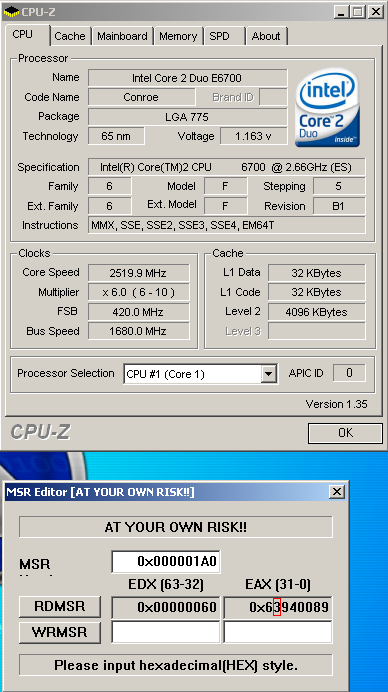
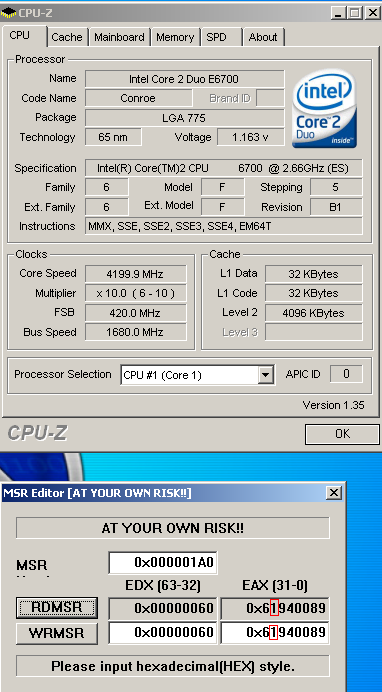
For the ordinary user technology EIST (Enhanced Intel SpeedStep Technology) allows to lower the processor frequency up to any minimal value, reducing the power requirement level , during idle time . Processors of family Core 2 Duo E6xxx support EIST technology , the minimal multiplier is equal 6x, that allows models of 1066 MHz bus to work on frequency of 1.6 GHz during the idle time. The power requirement level in such condition will not exceed 22 w. Preparing the announcement of the fourth quarter processor Core 2 Duo E4200 with frequency of 1.6 GHz and 800 MHz bus.the processor in this economic mode will work at frequency of 1.2 GHz. However, overclocker for a long time are trying to switch off such technologies In their opinion, work with such technologies leads to worst overclocking capability to get rid from EIST , owners of processors Conroe stepening B0 and B1 step-by-step instructions are given. So, utilities CPU-Z will be necessary for operation and CrystalCPUID ( MSR Editor of section Function of the main menu) for us. 1. To the field "MSR" write 0x000001A0. 2. press button " RDMSR " for data read-out. 3. copy the top"high" 32 bit register EDX in the bottom field for data input (value should be equal 0x00000060 or something similar). 4. copy the bottom"low" 32 bit register EAX in the bottom field for data input (value should be equal 0x63940089 or something similar). 5. replace figure " 3 " on "1" in led round red positions (the result should look like 0x61940089 or similar). 6. press button " WRMSR " for data recording. The processor multiplier now should accept the maximal value (in this case 10x), it will not decrease within the limits of EIST work . Let's notice, that editing MSR registers can turn back with unpredictable results, therefore manipulations you will make all at own risk. Most likely, the option of switching-off EIST will appear in BIOS of many motherboard with Conroe support , and necessity of similar manipulations will disappear. Actually, function EIST brings more advantage, than harm | ||
|
|
||
|
xtreview is your : Video card - cpu - memory - Hard drive - power supply unit source |
|
|
|
|
||
|
Xtreview Support  N-Post:xxxx Xtreview Support  |
DISABLE CONROE EIST |
| Please Feel Free to write any Comment; Thanks  |
Samsung will be able to remotely disable Galaxy Note 7 (2016-09-13)
Security Update OS X disables the Ethernet-port (2016-02-29)
Microsoft is not going to disable the collection of information in Windows 10 (2016-02-12)
Google disables webcam video capture from YouTube (2015-12-15)
Skylake bus overclock force disable the built-in graphics (2015-12-12)
Asus believes that it can disable discrete graphics cards (2014-06-05)
NVIDIA recognizes a problem in 3D-card GeForce GTX 600 series and offers a solution to disable V-Sync (2012-05-19)
Phenom TLB disable tool (2008-03-21)
Disable TLB patch for all motherboard (2008-03-17)
disable conroe EIST (2006-06-28)

To figure out your best laptops .Welcome to XTreview.com. Here u can find a complete computer hardware guide and laptop rating .More than 500 reviews of modern PC to understand the basic architecture


7600gt review
7600gt is the middle card range.
We already benchmarked this video card and found that ...
 geforce 8800gtx and 8800gts Xtreview software download Section AMD TURION 64 X2 REVIEW INTEL PENTIUM D 920 , INTEL PENTIUM D 930 6800XT REVIEW computer hardware REVIEW INTEL CONROE CORE DUO 2 REVIEW VS AMD AM2 INTEL PENTIUM D 805 INTEL D805 Free desktop wallpaper online fighting game Xtreview price comparison center
Rss Feeds


- The new version of GPU-Z finally kills the belief in the miracle of Vega transformation
- The motherboard manufacturer confirms the characteristics of the processors Coffee Lake
- We are looking for copper coolers on NVIDIA Volta computing accelerators
- Unofficially about Intels plans to release 300-series chipset
- The Japanese representation of AMD offered monetary compensation to the first buyers of Ryzen Threadripper
- This year will not be released more than 45 million motherboards
- TSMC denies the presentation of charges from the antimonopoly authorities
- Radeon RX Vega 64 at frequencies 1802-1000 MHz updated the record GPUPI 1B
- AMD itself would like to believe that mobile processors Ryzen have already been released
- AMD Vega 20 will find application in accelerating computations
- Pre-orders for new iPhone start next week
- Radeon RX Vega 57, 58 and 59: the wonders of transformation
- ASML starts commercial delivery of EUV-scanners
- The older Skylake processors with a free multiplier are removed from production
- Meizu will release Android-smartphone based on Helio P40
- AMD Bristol Ridge processors are also available in American retail
- The fate of Toshiba Memory can be solved to the next environment
- duo GeForce GTX 1080 Ti in GPUPI 1B at frequencies of 2480-10320 MHz
- New Kentsfield overclocking record up to 5204 MHz
- Lenovo released Android-smartphone K8












computer news computer parts review Old Forum Downloads New Forum Login Join Articles terms Hardware blog Sitemap Get Freebies


