Intel officially introduced Ivy Bridge processors

|
xtreview is your : Video card - cpu - memory - Hard drive - power supply unit source |
|
|||
|
|
||||


 Recommended : Free unlimited image hosting with image editor
|
POSTER: computer news || INTEL OFFICIALLY INTRODUCED IVY BRIDGE PROCESSORS |
DATE:2012-04-23 |
|
|
Intel finally introduced the Intel Core third generation, known under the code name Ivy Bridge. These solutions have become the world's first processors built on 22 nm technological standards with the use of three dimensional transistor Tri-Gate. All processors Ivy Bridge have a common crystal design , which implies the possibility of a simple chip scaling in order to create a diverse range of solutions in different price categories for the client and corporate market. The transition to new production technology in the strategy of Tick not only reduce the power consumption of processors Ivy Bridge by up to 20%, but also increase their speed by 20%. 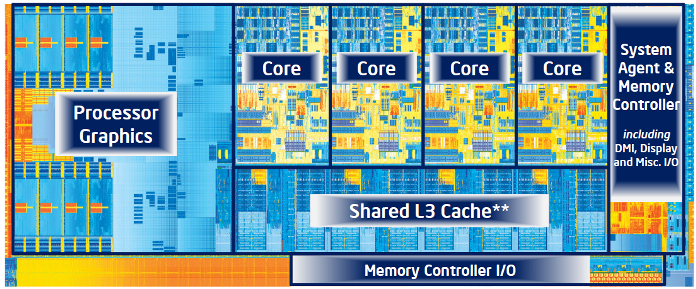 Each of the four cores has 256KB cache in the second level, and also has access to 8 MB (volume, however, depends on the model) in the third-level . Third cache level is shared not only between the cores, but also with the graphics system. Ivy Bridge supports 16 line interface PCI Express 3.0, which can be shared between multiple graphics cards under 8 +8 or 8 + 4 + 4 (depending on the model of the motherboard and chipset). Among other things, the processor provides superior instruction block AVX and AES-NI, as well as the graphics engine that supports API DirectX 11 and participating in the acceleration of certain problems (such as video encoding technology within QuickSync). In the area of 160 sq. mm chip are placed 1.4 billion transistors. The range of processors Ivy Bridge consists of 9 models, details can be found on the slides below (note that senior TDP processors is 77 watts, not 95, as the label on the box with the product). With regard to mobility, it will be released initially in five models: Core i7-3615QM, Core i7-3610QM, Core i7-3612QM, Core i7-3720QM, Core i7-3820QM and Core i7-3920XM. 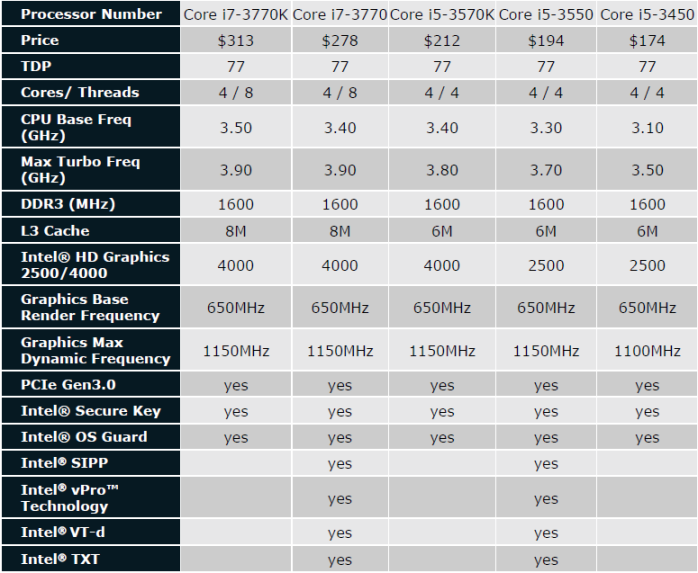 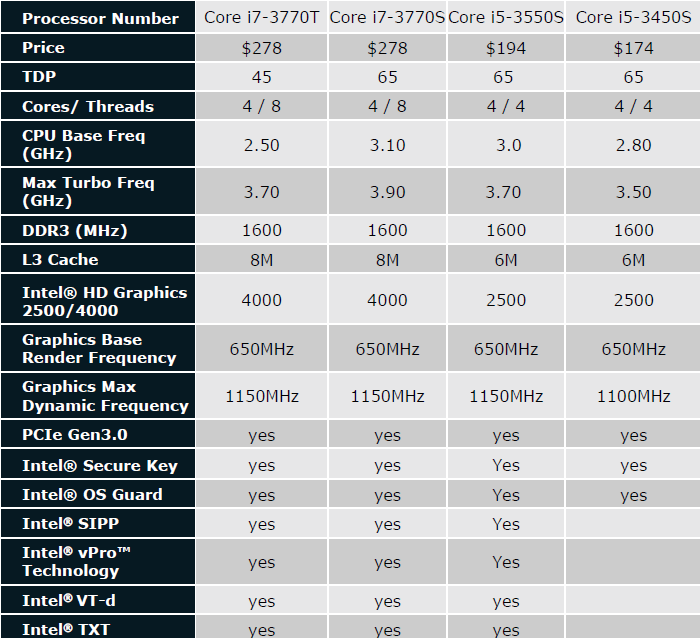 Sales of Ivy Bridge processors first wave will begin on 29 April. Related Products : | ||
|
|
||
|
xtreview is your : Video card - cpu - memory - Hard drive - power supply unit source |
|
|
|
|
||
|
Xtreview Support  N-Post:xxxx Xtreview Support  |
INTEL OFFICIALLY INTRODUCED IVY BRIDGE PROCESSORS |
| Please Feel Free to write any Comment; Thanks  |
Unofficially about Intels plans to release 300-series chipset (2017-09-08)
AMD EPYC processors are officially presented (2017-06-21)
Huawei Honor 9 with Kirin 960 and dual main camera presented officially (2017-06-13)
Metro Exodus officially announced (2017-06-12)
The Evil Within 2 is officially released (2017-06-12)
Meizu M5c with a 3000 mAh battery is officially presented (2017-05-23)
Smartphone Samsung Z4 on Tizen 3.0 is officially presented (2017-05-15)
Oppo F3 with dual front camera presented officially (2017-05-04)
Corsair memory, officially approved for use with AMD Ryzen, is on sale (2017-04-18)
Star Wars Battlefront II is officially presented (2017-04-17)
Sharp Z3 with QHD-display and 4 GB of RAM is officially presented (2017-04-13)
Huawei officially introduced Android-smartphone P10 lite (2017-03-18)
Radeon RX Vega name confirmed officially (2017-03-01)
Meizu M5s with an 8-core processor and fast charging officially presented (2017-02-15)
Samsung has officially announced the reasons for Galaxy Note 7 explosion (2017-01-23)
Unofficially HBM2 memory availability (2017-01-10)
ZTE officially introduced Blade V8 Pro with Dual Camera (2017-01-05)
Qualcomm Snapdragon 835 officially announced (2017-01-04)
Xiaomi officially unveiled Mi Notebook Air with support for 4G (2016-12-24)
ZUK Edge on the Snapdragon 821, officially presented (2016-12-21)

To figure out your best laptops .Welcome to XTreview.com. Here u can find a complete computer hardware guide and laptop rating .More than 500 reviews of modern PC to understand the basic architecture


7600gt review
7600gt is the middle card range.
We already benchmarked this video card and found that ...
 geforce 8800gtx and 8800gts Xtreview software download Section AMD TURION 64 X2 REVIEW INTEL PENTIUM D 920 , INTEL PENTIUM D 930 6800XT REVIEW computer hardware REVIEW INTEL CONROE CORE DUO 2 REVIEW VS AMD AM2 INTEL PENTIUM D 805 INTEL D805 Free desktop wallpaper online fighting game Xtreview price comparison center
Rss Feeds


- The new version of GPU-Z finally kills the belief in the miracle of Vega transformation
- The motherboard manufacturer confirms the characteristics of the processors Coffee Lake
- We are looking for copper coolers on NVIDIA Volta computing accelerators
- Unofficially about Intels plans to release 300-series chipset
- The Japanese representation of AMD offered monetary compensation to the first buyers of Ryzen Threadripper
- This year will not be released more than 45 million motherboards
- TSMC denies the presentation of charges from the antimonopoly authorities
- Radeon RX Vega 64 at frequencies 1802-1000 MHz updated the record GPUPI 1B
- AMD itself would like to believe that mobile processors Ryzen have already been released
- AMD Vega 20 will find application in accelerating computations
- Pre-orders for new iPhone start next week
- Radeon RX Vega 57, 58 and 59: the wonders of transformation
- ASML starts commercial delivery of EUV-scanners
- The older Skylake processors with a free multiplier are removed from production
- Meizu will release Android-smartphone based on Helio P40
- AMD Bristol Ridge processors are also available in American retail
- The fate of Toshiba Memory can be solved to the next environment
- duo GeForce GTX 1080 Ti in GPUPI 1B at frequencies of 2480-10320 MHz
- New Kentsfield overclocking record up to 5204 MHz
- Lenovo released Android-smartphone K8












computer news computer parts review Old Forum Downloads New Forum Login Join Articles terms Hardware blog Sitemap Get Freebies


