Foxconn x58 digital life

|
xtreview is your : Video card - cpu - memory - Hard drive - power supply unit source |
|
|||
|
|
||||

 Recommended : Free unlimited image hosting with image editor
|
POSTER: computer news || FOXCONN X58 DIGITAL LIFE |
DATE:2008-10-04 |
|
|
In xtremeSystems.org appeared the photograph of the motherboard foxconn x58 digital life.
As it was explained, the built-in memory controller and QPI bus selection are critical for new generation Intel processors . In particular, for the maximum bus overclock , default value equal to 133 MHz, it is necessary to reduce the QPI multiplier, otherwise it will be overclocked synchronously with the processor core, and sooner or later it will limit the general overclock. QPI frequency do not influences the performance of single-processor systems (low influences); therefore user can reduce the QIP multiplier without performance loss . Experimentally it was possible to reduce the QPI multiplier and the max frequency was 220 MHz. In case of core i 7-920 (2.66 GHz) processor, which does not possess the free multiplier, this will indicate reaching the limiting overclock frequency at the level of 4400 MHz (20 X 220 MHz). For overclock with air cooling , this is completely sufficient,. 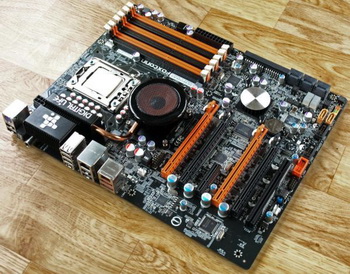 If we speak about the foxconn motherboard on base of Intel x58 chipset, then such motherboard will be the moderate collection of overclocking possibilities . The processor power system has six phases, the DDR3 memory modules can be placed in the valuable six slots DIMM, four slots PCI express x16 are ready to place up to four video card (real capacity of each slot is lower than PCI express x16). 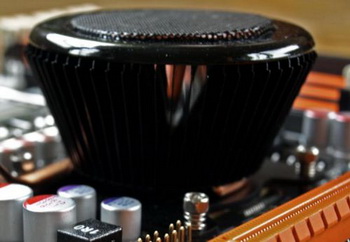 Here is the northbridge cooler. 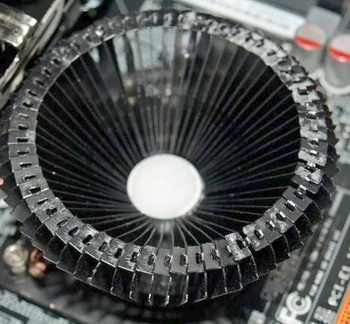 The motherboard bios include diverse setting for memory overclock - from DDR 3-800 to DDR 3-2000. In the second place, a memory working with more than 1.65v does not always result in processor loss . As asserts SF 3d, it exploited some memory modules with voltage more than 1.8 v for a period of two days, and this has not caused any problems with the processor. Failure in this situation was only for early processors models , and series copies stably work with high memory voltage . However, this has to be confirmed , Asus for example note clearly to not exceed 1.65v . Related Products : | ||
|
|
||
|
xtreview is your : Video card - cpu - memory - Hard drive - power supply unit source |
|
|
|
|
||
|
Xtreview Support  N-Post:xxxx Xtreview Support  |
FOXCONN X58 DIGITAL LIFE |
| Please Feel Free to write any Comment; Thanks  |
Gigabyte X58A-OC motherboard (2012-07-30)
Intel end X58 chipset production (2011-10-05)
ZotacEATX X58 motherboard (2011-07-15)
Sparkle Calibre X580 Captain (2011-07-13)
Chipsets AMD 990FX vs Intel X58 graphic sata and usb performance (2011-07-03)
Asus matrix GTX580 (2011-05-26)
Asus MARS II and Matrix GTX580 on computex 2011 (2011-05-25)
Gigabyte GA -X58A-oc on sale (2011-05-06)
Gigabyte GTX580 SuperOverclock released (2011-04-15)
Gigabyte GA -X58A-oc will cost 500 dollars (2011-04-14)
Asrock x58 extreme6 (2011-03-03)
Gigabyte GA -X58A-oc (2011-03-02)
Gigabyte X58A-OC extreme overclock motherboard (2011-02-27)
Gigabyte X58A-OC (2011-02-22)
GIGABYTE X58A-OC (2011-01-24)
Palit Geforce GTX580 3gb (2011-01-21)
Sapphire Pure black x58 (2011-01-13)
DX58SO2 smackOver II and DX58OG (2011-01-03)
Killer x58 (2010-12-24)
EVGA x58 classified3 (2010-10-05)

To figure out your best laptops .Welcome to XTreview.com. Here u can find a complete computer hardware guide and laptop rating .More than 500 reviews of modern PC to understand the basic architecture


7600gt review
7600gt is the middle card range.
We already benchmarked this video card and found that ...
 geforce 8800gtx and 8800gts Xtreview software download Section AMD TURION 64 X2 REVIEW INTEL PENTIUM D 920 , INTEL PENTIUM D 930 6800XT REVIEW computer hardware REVIEW INTEL CONROE CORE DUO 2 REVIEW VS AMD AM2 INTEL PENTIUM D 805 INTEL D805 Free desktop wallpaper online fighting game Xtreview price comparison center
Rss Feeds


- The new version of GPU-Z finally kills the belief in the miracle of Vega transformation
- The motherboard manufacturer confirms the characteristics of the processors Coffee Lake
- We are looking for copper coolers on NVIDIA Volta computing accelerators
- Unofficially about Intels plans to release 300-series chipset
- The Japanese representation of AMD offered monetary compensation to the first buyers of Ryzen Threadripper
- This year will not be released more than 45 million motherboards
- TSMC denies the presentation of charges from the antimonopoly authorities
- Radeon RX Vega 64 at frequencies 1802-1000 MHz updated the record GPUPI 1B
- AMD itself would like to believe that mobile processors Ryzen have already been released
- AMD Vega 20 will find application in accelerating computations
- Pre-orders for new iPhone start next week
- Radeon RX Vega 57, 58 and 59: the wonders of transformation
- ASML starts commercial delivery of EUV-scanners
- The older Skylake processors with a free multiplier are removed from production
- Meizu will release Android-smartphone based on Helio P40
- AMD Bristol Ridge processors are also available in American retail
- The fate of Toshiba Memory can be solved to the next environment
- duo GeForce GTX 1080 Ti in GPUPI 1B at frequencies of 2480-10320 MHz
- New Kentsfield overclocking record up to 5204 MHz
- Lenovo released Android-smartphone K8












computer news computer parts review Old Forum Downloads New Forum Login Join Articles terms Hardware blog Sitemap Get Freebies


