Intel Sandy Bridge architecture update

|
xtreview is your : Video card - cpu - memory - Hard drive - power supply unit source |
|
|||
|
|
||||


 Recommended : Free unlimited image hosting with image editor
|
POSTER: computer news || INTEL SANDY BRIDGE ARCHITECTURE UPDATE |
DATE:2009-10-04 |
|
|
According to Intel concept Tick-Tock, each year, the company updates the production technical process , and the micro-architecture of its processors. In the past year was presented the micro-architecture nehalem, in this year Intel begun the production of processors on 32 nm technical process, and in the following year it will present the micro-architecture sandy bridge. It was assumed that this architecture will be fundamentally new, developed from zero micro-architectures, and precisely it will become the answer to the new micro-architecture AMD M -Space.
Examining presentations from the passed IDF, we succeeded in explaining some details about Sandy bridge. Sandy bridge will not obtain fundamentally a new micro-architecture, but it will be satisfied by the finished nehalem : 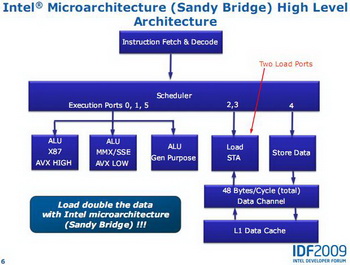 However, the tactics of bottleneck liquidation in the micro-architecture completely justify itself. Sandy bridge will obtain the optimized block of load and data retention (LSU : load store unit), which will allow to execute two operations of data load , instead of current one. Furthermore, the operations block bus with the floating point will be increased by twice , to 256- bits, which will allow , actually, to double the speed of its operation in certain cases. Besides quantitative improvements, the updated micro-architecture will obtain the support of AVX command collection . 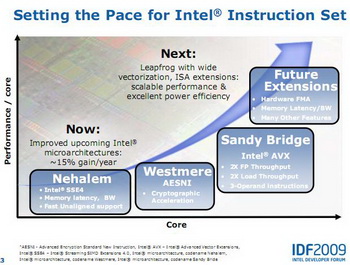 This will happen, probably in 2012, two years after the release Of sandy bridge, when micro-architecture will be updated . It is assumed that the code name of this processor is haswell. Thus, AMD has a chance to use the advantages of its new micro-architecture and to obtain again the status of the leader, which was lost after the release of core 2 processors. The basic accent with the development Of sandy bridge will be the decrease of energy consumption and increase in energy-effectiveness. Related Products : | ||
|
|
||
|
xtreview is your : Video card - cpu - memory - Hard drive - power supply unit source |
|
|
|
|
||
|
Xtreview Support  N-Post:xxxx Xtreview Support  |
INTEL SANDY BRIDGE ARCHITECTURE UPDATE |
| Please Feel Free to write any Comment; Thanks  |
Sandy Bridge record SuperPI 32M at a frequency of 5948 MHz (2016-12-20)
Haswell processors overclock by an average less 400 MHz than Sandy Bridge (2014-03-22)
Intel end production of Sandy Bridge-E processors (2014-03-05)
Sandy Bridge-E with couple GeForce GTX 780 Ti set a new record (2013-12-29)
In the third quarter, Intel completes delivery of almost all Sandy Bridge processors (2013-07-10)
Intel cleans Core i3, Pentium and Celeron processors Sandy Bridge generation (2013-02-06)
Intel says goodbye to many Sandy Bridge models (2012-09-26)
Intel removed some Sandy Bridge processors (2012-08-08)
Five new Sandy Bridge processors will appear in September (2012-07-27)
Intel removed four mobile processor Sandy Bridge (2012-06-22)
Sandy Bridge processors will get their successor in September (2012-06-12)
Intel will release four budget processor Sandy Bridge generation (2012-04-23)
Celeron and Pentium sandy bridge processors (2012-04-21)
Intel EOF Sandy Bridge (2012-03-30)
Intel Sandy Bridge-EP server processors Announced (2012-03-07)
Intel officially presented Sandy Bridge processors without integrated graphics (2012-01-30)
Sandy Bridge processors without integrated graphics will be released in 6 February (2012-01-13)
Intel will lower prices for mobile processors generation Sandy Bridge (2011-12-22)
C2 stepping Sandy Bridge-E will appear in January (2011-12-12)
Faster Sandy Bridge-E models will be released in the second quarter (2011-11-30)

To figure out your best laptops .Welcome to XTreview.com. Here u can find a complete computer hardware guide and laptop rating .More than 500 reviews of modern PC to understand the basic architecture


7600gt review
7600gt is the middle card range.
We already benchmarked this video card and found that ...
 geforce 8800gtx and 8800gts Xtreview software download Section AMD TURION 64 X2 REVIEW INTEL PENTIUM D 920 , INTEL PENTIUM D 930 6800XT REVIEW computer hardware REVIEW INTEL CONROE CORE DUO 2 REVIEW VS AMD AM2 INTEL PENTIUM D 805 INTEL D805 Free desktop wallpaper online fighting game Xtreview price comparison center
Rss Feeds


- The new version of GPU-Z finally kills the belief in the miracle of Vega transformation
- The motherboard manufacturer confirms the characteristics of the processors Coffee Lake
- We are looking for copper coolers on NVIDIA Volta computing accelerators
- Unofficially about Intels plans to release 300-series chipset
- The Japanese representation of AMD offered monetary compensation to the first buyers of Ryzen Threadripper
- This year will not be released more than 45 million motherboards
- TSMC denies the presentation of charges from the antimonopoly authorities
- Radeon RX Vega 64 at frequencies 1802-1000 MHz updated the record GPUPI 1B
- AMD itself would like to believe that mobile processors Ryzen have already been released
- AMD Vega 20 will find application in accelerating computations
- Pre-orders for new iPhone start next week
- Radeon RX Vega 57, 58 and 59: the wonders of transformation
- ASML starts commercial delivery of EUV-scanners
- The older Skylake processors with a free multiplier are removed from production
- Meizu will release Android-smartphone based on Helio P40
- AMD Bristol Ridge processors are also available in American retail
- The fate of Toshiba Memory can be solved to the next environment
- duo GeForce GTX 1080 Ti in GPUPI 1B at frequencies of 2480-10320 MHz
- New Kentsfield overclocking record up to 5204 MHz
- Lenovo released Android-smartphone K8












computer news computer parts review Old Forum Downloads New Forum Login Join Articles terms Hardware blog Sitemap Get Freebies


